
App Store Optimization for iOS and Android
You built the app. Nobody can find it.
Keywords, listing, screenshots and reviews, worked on the rules each store actually publishes, and reported in a way that shows you what our work did and what would have happened anyway.
Ranking, listing and creative measured against the store’s own numbers, not ours.
Most apps do not fail because they are bad. They fail because nobody sees them. The store search box is where a large share of app discovery starts, so a listing that does not rank for what people type turns your marketing budget into a subsidy for a problem your store page created.
ASO is the cheapest download you will ever buy, because it works on traffic you already have. It is also the corner of this industry with the most confident nonsense in it: unsourced statistics, guaranteed rankings, and results reported without any attempt to separate the agency’s work from the season. This page is written to be checkable. Where a number comes from Apple or Google, we link to Apple or Google. Where a number is an estimate, we say estimate.
Who you’ll actually work with

Anand Yadav
We wrote the store listing for every app we ever launched. It was always part of the job and we never charged for it separately, which meant nobody ever looked at it closely. That was a mistake. The listing is often the cheapest growth available and it is usually the least-examined thing a client owns.
The reason I was slow to sell this as a service is that ASO has a bad name, and it deserves some of it. Too much of it is a screenshot of a graph going up. So we do it the other way round: we write down what your numbers look like before we touch anything, we change one thing at a time where the store lets us test, and if a month’s growth cannot be separated from the season or your ad spend, the report says so.
I would rather send you a report that says ‘we cannot tell yet’ than one that takes credit for Christmas.
What usually goes wrong
What clients say, and what it actually means
“Our downloads dropped and marketing says it is the algorithm.”
What it meansNobody checked whether the listing itself still matched what the app does now.
“We just need better keywords and we will rank higher.”
What it meansRank without conversion just means more people bounce off the listing.
“The screenshots looked great when we launched two years ago.”
What it meansThe store rewards what is current, not what once worked.
06. What we actually do
| Work | What it means | Which store |
|---|---|---|
| Keyword research from your own reviews first | Your users have already written your keywords for you. We read the review corpus for the words real people repeat, then check volume, difficulty and relevance. This is where we start, because it is the only keyword source that is not a guess. | Both |
| Title, subtitle and keyword field | Apple gives you 30 characters for the name, 30 for the subtitle, and a 100-character keyword field: comma-separated, no spaces, no repeats of words already in the name or subtitle. Most apps waste at least one of the three. | Apple |
| Long description, written for humans and for policy | Google says the description helps users discover your app and warns explicitly that keyword spamming is a policy violation. We write it to read well and stay inside the rules. See section 07 for what Google does not say about it. | |
| Screenshots and preview video | The biggest single lever on install rate. Most store pages show screens. The ones that convert show what the app gets you. Designed and delivered, not just directed. | Both |
| Icon and creative testing | Run inside the stores’ own experiment tools so the result is measured by the store, not by us. Limits in section 07. | Both |
| Ratings and review operations | Prompts placed at the moment a user has just succeeded at something, inside Apple’s limit of three prompts per user per 365 days, plus a response process for reviews. | Both |
| Localisation | Listings translated and re-keyworded per market, not translated and left. Often the fastest growth available for an app that already works. | Both |
| Competitor teardown | What they rank for that you do not, and what their creative is doing that yours is not. | Both |
| The baseline, before anything changes | Written down and agreed on day one. Without it, nothing later can be measured. Detail in section 08. | Both |
07. What the stores actually say
ASO is full of confident claims about how the stores rank apps. Very little of it comes from Apple or Google.
Here is what they publish, with links, and here is where the popular version is wrong.
What search ranks on
“Search results are based on… text relevance (matches for your app’s title, subtitle, keywords, and primary category), as well as user behavior (downloads, ratings and reviews, and more).”
Keyword field
100 characters, comma-separated, no spaces. Do not repeat words already in the name or subtitle. Avoid plurals, generic terms and filler.
Promotional text
“Promotional text doesn’t affect your app’s search ranking so it should not be used to display keywords.” Most ASO pages get this wrong.
Product Page Optimization (testing)
Up to 3 treatments against the original. Icons, screenshots and previews only, not text. One test at a time. Runs up to 90 days. iOS 15+. Apple recommends waiting for 90% confidence.
Custom Product Pages
Up to 70 additional product pages, each with its own URL, varying screenshots, promo text and previews. Deep links from iOS 18.
Review prompts
Up to three prompts per user per 365 days.
Incentivised reviews
Manipulating reviews, or using “paid, incentivized, filtered, or fake feedback, or… third-party services to do so on your behalf”, risks expulsion from the Developer Program.
Google Play, what is documented, and what is not
| Thing | What Google says | Source |
|---|---|---|
| What ranking is based on | “Apps are ranked based on a combination of ratings, reviews, downloads, and other factors.” Google calls the weighting “a proprietary part of the Google search algorithm” and publishes nothing further. | support.google.com/googleplay/android-developer/answer/4448378 |
| Store listing experiments | Up to 2 variants. Either one default graphics experiment or up to five localised experiments at a time. Localised tests can cover descriptions in up to 5 languages. Auto-stop at 6 months. Google advises testing for at least a week. | support.google.com/googleplay/android-developer/answer/12053285 |
| Custom store listings | Up to 50, targeted by country, ads traffic, search keyword, pre-registration, or churned/lapsed/buyer segments. One custom listing per country at a time. | support.google.com/googleplay/android-developer/answer/9867158 |
| Keyword spamming | A policy violation. Not a growth tactic. | Same as ranking URL |
The correction: we have written this wrong ourselves
Our own earlier draft of this page said Google “reads the full description and pays attention to engagement and retention” as a ranking mechanic. Google does not say that. Google says ranking uses ratings, reviews, downloads “and other factors”, and calls the weighting proprietary. The long description helps users discover and understand your app, and Google gives SEO-style writing advice for it, but any agency telling you the exact ranking weight of a Play description is asserting beyond the public record, and we were doing it too.
This matters practically: it is the reason we write the Play description to read well and stay inside policy, rather than stuffing it and calling that a strategy.
Stat Breakdown & Future Roadmap
The 65% myth, and what’s coming
The statistic everyone in this industry quotes, including us, unpacked, dated, and verified against first-party store sources.
01. The Statistic & First-Party Evidence
Industry lore says: “65% of app downloads come from App Store search.” (often attributed to Apple in 2016).
Here is what Apple actually publishes: “70% of App Store visitors use search to discover apps” and “Almost 65% of downloads happen directly after a search.”
First-Party Source
It is genuine first-party data directly from Apple, which is far better and more authoritative than most people who quote it realize.
2022 Data in 2026
It is 2022 data being quoted on 2026 pages (including, until today, ours). Store dynamics and algorithms evolve continuously.
Ad Sales Context
It lives on Apple’s advertising page selling Search Ads, not developer technical docs. That doesn’t make it false, but context matters.
The 'Apple 2016' Confusion
The widely-repeated “Apple, 2016” attribution appears to be a different figure entirely: a 2017 App Annie retrospective that got collapsed into the Apple statistic over time.
No Play Store Equivalent
Google publishes no equivalent figure at all. Any “X% of Play downloads come from search” claim you see has no first-party source that we could find.
02. Coming, and it changes the job
developer.apple.com/app-store/whats-newApple’s published plans for Fall 2026 introduce major updates that reshape store optimization from a copywriting task into a continuous creative workflow:
Visual Marketing Assets
Rich images and video in product page headers, search results, and editorial features. Search results become a visual creative surface rather than just text.
Asset Library
A dedicated Asset Library in App Store Connect that lets you submit and pre-approve visual assets independently of app code releases.
Preview Tooling
A new Product Page Preview Tool enabling accurate pre-flight preview and testing of visual treatments before deployment.
Two consequences worth planning for: Search results become a creative surface rather than a text one, and creative updates stop being tied to binary app releases.
If you are budgeting ASO for 2027, budget more design and less copywriting than you would have in 2025.
08. Attribution: the part nobody else writes down
This is the objection that kills ASO deals, and no agency page we studied answers it.
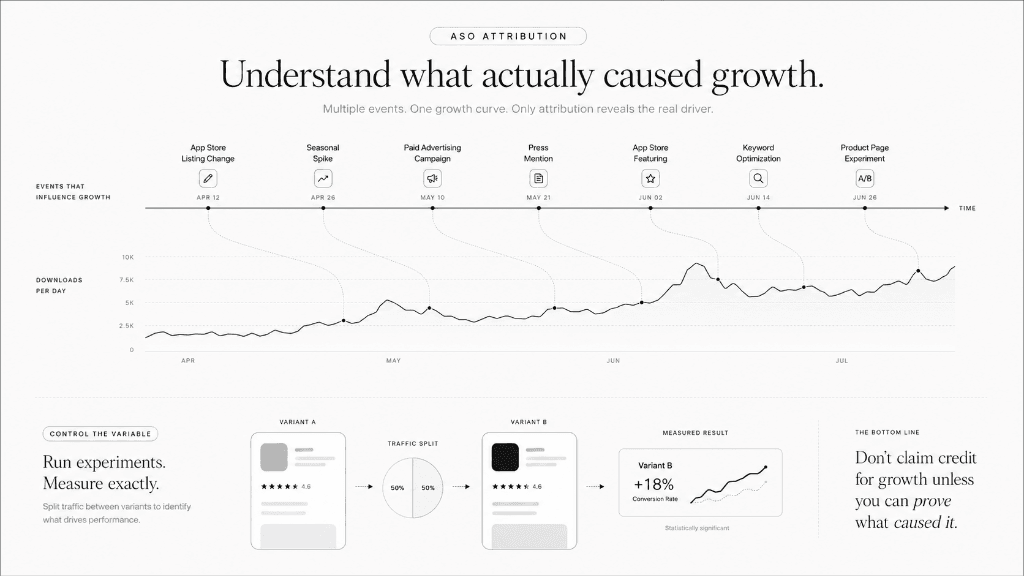
Downloads went up. Was that the listing, the season, your ad spend, a press mention, or the store featuring you?
If nobody can answer that, you are paying a monthly fee against a graph.
Four things we do about it, on every engagement.
A written baseline before anything changes
Impressions, product page views, conversion rate, installs, keyword positions and rating, agreed and dated on day one. Everything afterwards is measured against a number you signed off, not one we produce later.
Store-run experiments wherever the store offers one
Apple’s Product Page Optimization and Google’s store listing experiments split real traffic and are measured by the store, not by us. Where a change can be tested this way, it gets tested this way, and the result is Apple’s or Google’s number, not ours.
One change at a time, on a dated change log
Every listing change is dated and logged. The monthly report puts the change log on the same timeline as the numbers, so you can see what preceded what.
A holdout store where it is possible
When an app is on both stores and only one needs work first, the untouched store becomes a rough control for seasonality. It is not a clean experiment and we will not pretend it is, but a season affects both stores and a listing change affects one.
And the part that matters most:when a month’s movement cannot be separated from seasonality, a paid campaign or a store feature, the report says exactly that. We would rather write “we cannot attribute this yet” than take credit for a good quarter you were going to have anyway.
What we cannot do. There is no way to run a true controlled experiment on organic store search. Neither store offers a holdout on keyword ranking. Anyone claiming clean causal attribution on organic ASO is overselling, including us if we ever do it. The four things above are the best available, not a proof.
10. Start with the audit
Fixed price. Five working days.
Credited back in full against your first month if you continue.
Why we changed this to a paid audit: An earlier version of this page offered a free listing review. We changed it, and the reasoning is worth stating: a free review has to be paid for by the recommendation, which means the verdict is carrying a sales quota. Charging a fixed fee and crediting it back means we can spend five days on the analysis instead of two hours producing a postcode, and it means that when the audit says “your problem is the product, not the listing”, that verdict costs us the follow-on work and we deliver it anyway.
11. WHERE AI HELPS HERE
Where it genuinely helps.
Working through large keyword sets and competitor listings at a scale that is not practical by hand. Reading your entire review corpus, often thousands of reviews, for the words real users repeat, which is the best keyword source you own. Drafting many description and screenshot-caption variants quickly so that testing has something to test.
Where it does not.
Positioning. What the app is for, and which promise goes in the first screenshot, is a judgement about your business that a model cannot make and should not be asked to. Nor does AI change the store rules: Apple’s keyword field is still 100 characters, Google still treats keyword stuffing as a policy violation, and generating more text does not create more ranking surface.
A human makes the final call on what goes live. That is not a philosophical position, it is because the two places ASO goes badly wrong, spam-adjacent metadata and a listing that misrepresents the app, are both judgement failures, and both are punished by the stores.
13. Standards
How we work to spec
Nothing goes live without your approval. We draft, you approve, we ship. Your listing is your storefront and you keep the final say on every word.
One change at a time where we are measuring. Bundling six changes and reporting the total is how ASO becomes unfalsifiable.
Store tools first, our opinion second. If Apple or Google offer a way to test something, we use it, and their number goes in the report.
Every claim in a listing has to be true of the app. Misleading metadata is a review rejection and a trust problem. It is also the fastest way to turn an install into a one-star review.
Screenshots are designed, not screenshotted. Delivered as final assets at both stores’ required sizes, ready to upload.
Localisation means re-keyworded, not translated. A translated listing that keeps the English keyword strategy is a wasted market.
We report in your numbers, not ours. The figures in the monthly report come from App Store Connect and Play Console and you can check every one of them yourself.
Where we have shipped
Industries we serve






Why the listing matters
The store page is the last thing between you and an install
Most of the budget goes into getting somebody as far as that page. What happens in the next eight seconds decides whether any of it counted. Everything below aims at those eight seconds.

15. Process
How the work runs
First call
Your store link, your numbers, what you have tried. We tell you on this call if ASO is the wrong spend. No charge.
ASO Audit
Keyword gap, listing teardown, conversion read, review-corpus extract, and your written baseline. Fixed fee, credited back.
Baseline agreed and dated
You sign off the numbers we will measure against. Nothing changes before this.
Metadata pass
Title, subtitle, keyword field, descriptions, both stores, on each store’s own rules. Drafted, approved by you, shipped.
Creative pass
Screenshots and preview video designed and delivered at both stores’ required sizes.
Testing
Apple PPO and Play store listing experiments, one test at a time, run to the store’s own confidence threshold.
Reviews and ratings
Prompt placement inside Apple’s three-per-year limit, plus a review response process.
Monthly report
Your numbers from your consoles, the dated change log on the same timeline, and what we could and could not attribute.
17. How we work together
| Model | Best for | Price |
|---|---|---|
| Audit only | You want to know what is wrong and fix it yourself, or take it to your team. A legitimate outcome and plenty of clients stop here. | Fixed fee Fee needed, credited back if you continue |
| One-off listing overhaul | The listing has never been worked on. Metadata and creative rebuilt once, with a before/after report against the baseline. | Price needed |
| Listing plan, monthly | Keyword tracking, metadata iteration, review operations and monthly reporting. | Price needed |
| Growth plan, monthly | Everything above plus continuous creative testing, localisation into your priority markets, and competitor tracking. | Price needed |
| Pre-launch setup | Before day one, when it is cheapest. The listing built right from the start, and the baseline set at zero, which is the only truly clean measurement you will ever get. | Quoted per app |
No minimum contract size. Monthly plans run month to month with 30 days’ written notice. No lock-in, no exit fee.
The pre-launch note is worth reading twice: an app that has not launched has no history to confound the measurement. It is the one situation where attribution is genuinely clean.
WALL OF PROOF
What clients say once the project is over
The SightInfusion team delivered our app with impressive speed, clear communication, and reliable quality. Every detail was handled thoughtfully, and the final result exceeded expectations. A professional team we're excited to work with again soon.
Working with SightInfusion was a smooth and professional experience. The team was proactive, technically strong, and always transparent with updates. Our finance app was delivered on time with great care. We look forward to future projects together.
SightInfusion handled our complex project with patience, expertise, and consistent communication. Their team learns fast, solves challenges quickly, and delivers dependable results. A skilled, trustworthy team we'll confidently partner with again in the future.
19. Tools we use
 App Store Connect
 Google Play Console
 Figma
FigmaNothing in the first row is optional for us. Where the store offers a way to measure a change, we use the store’s tool and the store’s number, because a result from Apple is worth more than a result from us.
21. Questions
How long until we see results?
Ranking movement usually starts within a few weeks. The useful gains accumulate over months. The most specific published figures we found are 2 to 4 weeks on iOS and 1 to 3 weeks on Google Play for ranking movement, 4 to 8 weeks for a creative test to reach significance, and 3 to 6 months for sustained growth, published by a large ASO agency without methodology, so treat them as an experienced estimate rather than a benchmark. They match what we see.
How do I know it was your work and not just seasonality?
Sometimes you will not, and we will say so in the report. What we do about it: a written baseline agreed before anything changes, store-run experiments wherever Apple or Google offer one so the number comes from them rather than us, one change at a time on a dated change log, and where you are on both stores, using the untouched store as a rough control. Full detail in section 08, including what this approach cannot do.
Is it true that 65% of downloads come from search?
Apple publishes that figure, and also that 70% of App Store visitors use search, on its advertising site, footnoted “Source: App Store, worldwide, 2022”. So it is first-party, it is four years old, and it lives on a page selling Search Ads. The version attributed to “Apple, 2016” that circulates widely appears to be a different, non-Apple figure that got merged with it. Google publishes no equivalent number at all.
Do you guarantee a number one ranking?
No, and nobody honest does. Neither store publishes its ranking weights, and Google explicitly calls its weighting proprietary. We guarantee the work and we report the numbers from your own console.
Do you need our source code?
No. Listing work needs store access only. In-app review prompts need a small code change, which we can do or hand to your team with the code.
Can you do this for an app you didn’t build?
Yes. Most ASO clients come to us that way.
How does Google rank apps? What does the long description do?
Google says ranking is “based on a combination of ratings, reviews, downloads, and other factors” and calls the weighting proprietary. That is the whole public record. The description helps users discover and understand your app, and Google gives writing advice for it, but nobody outside Google knows its ranking weight. Anyone quoting you a number is guessing. We write it to read well and to stay clear of keyword spamming, which is a stated policy violation.
What can actually be tested, and how?
On Apple: Product Page Optimization runs up to three treatments against your original, on icons, screenshots and previews only, one test at a time, for up to 90 days, and Apple suggests waiting for 90% confidence. On Google: store listing experiments run up to two variants, either one default graphics test or up to five localised tests at once, and auto-stop at six months. Text is testable on Google, not on Apple.
What about custom product pages?
Apple allows up to 70 additional product pages, each with its own URL and its own screenshots, promo text and previews, very useful for matching a paid campaign or a channel to a tailored page. Google’s equivalent is custom store listings, up to 50, targeted by country, ads traffic, keyword or user segment, with one custom listing per country at a time.
Can you get us more five-star reviews?
We can place the prompt where a user has just succeeded at something, inside Apple’s limit of three prompts per user per 365 days, and we can put a review-response process in place. What we will not do is incentivised, filtered, paid or fake reviews. Apple’s guidelines name expulsion from the Developer Program as a possible consequence, and it is not a risk worth taking for any rating.
Is ASO pointless because ads sit above the organic results?
Partly fair. Paid placements do appear above organic on high-volume terms. Two things follow: the terms where you can realistically win are usually not the ones with the heaviest ad competition, and conversion work helps your paid installs too. A store page that converts badly makes every ad you buy more expensive. On an app that already has traffic we usually work on conversion before rankings for exactly this reason.
Do you handle paid ads too?
Not as a service. ASO makes your ads cheaper by improving the page they land on, so it is worth doing first either way.
Is anything changing in the stores that we should plan for?
Yes. Apple’s published plans for Fall 2026 add visual marketing assets in product page headers, search results and editorial features, an Asset Library in App Store Connect so assets can be submitted and pre-approved independently of app releases, and a product page preview tool. Practically: search results become a creative surface rather than a text one, and creative stops being tied to your release schedule. Budget more design.
What if the audit says our problem isn’t the listing?
Then that is what it says, and you have spent an audit fee instead of a year of retainer. If the reviews point at the product, we will tell you and point you at App Rescue & Code Audit or a product conversation instead of selling you a listing refresh.



Tell us the problem. We bring the engineering.
A short call, an honest answer on whether we are the right team, and a scope you can hold us to.
Start a project